SiteTest.ai launches a free AI Visibility Checker for ChatGPT, Perplexity & Gemini
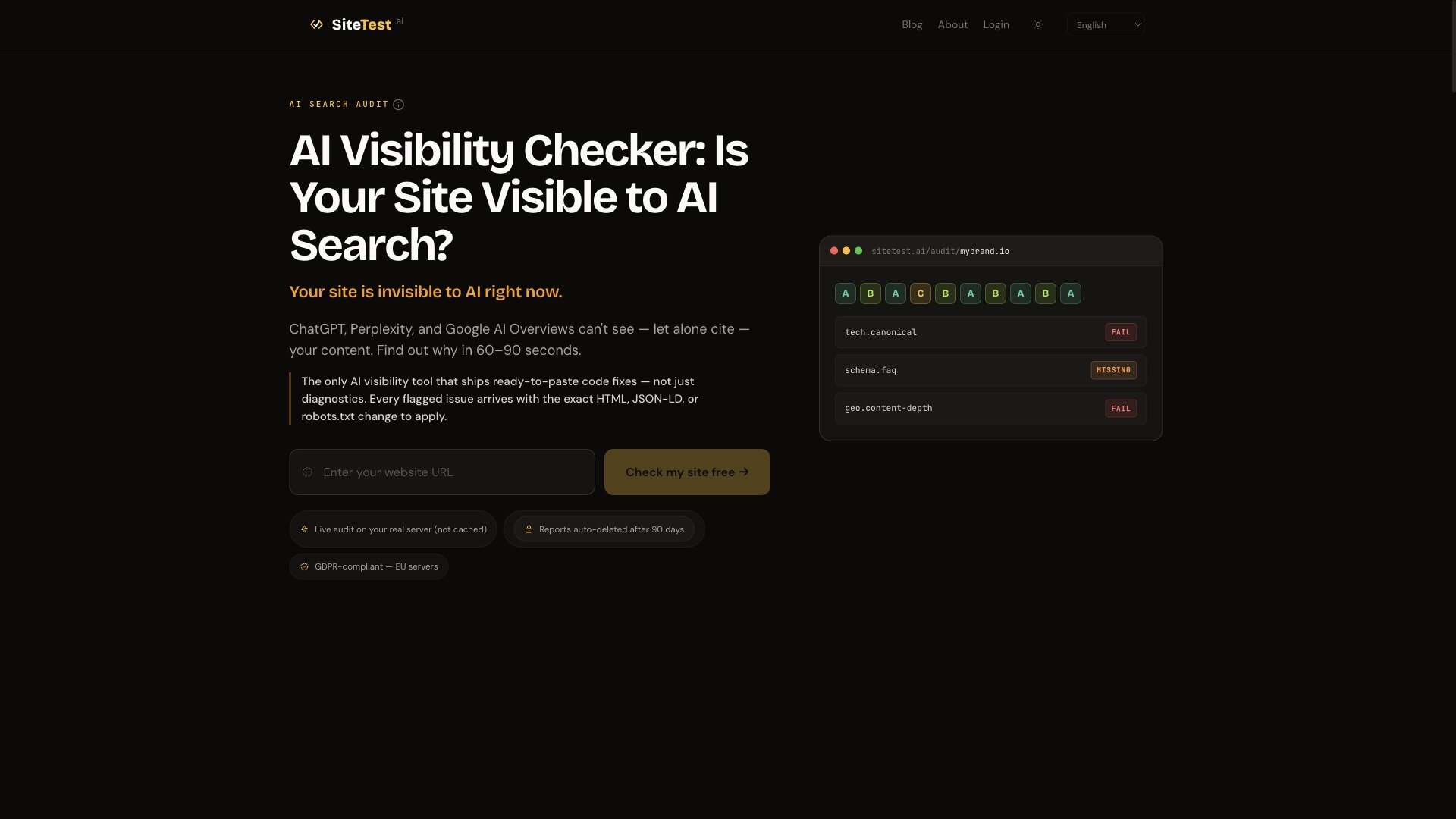
SiteTest.ai launches a free AI Visibility Checker for ChatGPT, Perplexity & Gemini
A new tool aimed at SEO teams and indie devs goes live: sitetest.ai runs a 168-point GEO audit of your site against the major AI search surfaces — ChatGPT, Perplexity, Google AI Overviews, Gemini and Bing Copilot — and ships copy-paste code fixes, not just a vibes report.
Why it matters
Most "AI visibility" checkers count keywords. SiteTest probes the actual AI crawlers (GPTBot, OAI-SearchBot, ChatGPT-User, PerplexityBot, Google-Extended, bingbot) on your real server and returns an A–F grade per engine. You see exactly where you are blocked — robots.txt, missing schema, JS-only rendering — and which platform-specific fix moves the needle.
What it does
- 168 checks across 10 categories — technical, on-page, content, performance, schema, security, accessibility, images, GEO, frontend.
- Per-engine scoring — separate readiness score for each AI surface, not one aggregate index.
- Brand-mention scanner — queries ChatGPT, Perplexity and Gemini for your brand, founder name, and product terms; logs whether you appear and how you are framed.
- Developer brief — exportable report with ready-to-ship HTML, JSON-LD and robots.txt fixes you can hand directly to engineering.
Pricing
Free tier covers the full audit (no signup, no card). Paid tiers ($4.99 / $24.99 one-time, no subscription) add the detailed developer brief, re-audits, and pro extensions. Pricing is intentionally low — closer to a one-time tool than to an SEO subscription.
Stack
Nuxt 3.21 with SSR and seven locales (en/uk/de/es/uz/kk/ru). The blog ships seven cornerstone articles on AI Search Engine Optimization, GEO and llms.txt, each translated into all seven languages. Backend: PostgreSQL + Redis + BullMQ for the audit queue, DeepSeek as the primary AI model with GPT-4.1-mini fallback.
Why this is interesting
AI search is fragmented. ChatGPT cites different sources than Perplexity. Gemini ranks differently from Bing Copilot. Most existing tools collapse this into one number. SiteTest treats each engine as a first-class target — which is closer to how the discipline actually plays out in 2026.
For SEO pros, the 168-point audit replaces a half-day manual checklist. For founders shipping a v1 site, it is the cheapest sanity check you can run before launch.
👉 Try it: https://sitetest.ai
👀 See Also
Pizza Bot: Self-Hosted Inbox for Long-Running AI Agents, Apache 2.0
Pizza Bot is a self-hosted desktop app for Mac, Windows, and Linux that runs AI agents in the background behind an email-style UI. Finished work lands in Unread, approvals queue in Action.

Corey Haines' Marketing Skills Set for AI Agents
A set of 25 marketing skills for AI agents has been added to OpenClaw, covering conversion optimization, copywriting, analytics, and growth engineering. The conversion optimization skill is noted as particularly effective in multi-agent setups.

RouteLLM Setup for Cost-Effective AI Task Routing
A Reddit user shares a Docker Compose configuration that combines Ollama's local Qwen3.5:4b model with GitHub Copilot via OpenWire, using RouteLLM to route complex tasks to GPT-4o while handling simpler tasks locally.

AI Code Review Benchmark: Claude, Gemini, Codex, Qwen, and MiniMax Compared
A benchmark tested five AI models on 15 Milvus pull requests with known bugs. Claude detected 53% of bugs in raw mode, while adversarial debate between models increased detection to 80%.