Mesh Architecture for AI Agents: Client Isolation and Cross-Project Coordination
Mesh vs. Hub-and-Spoke Architecture
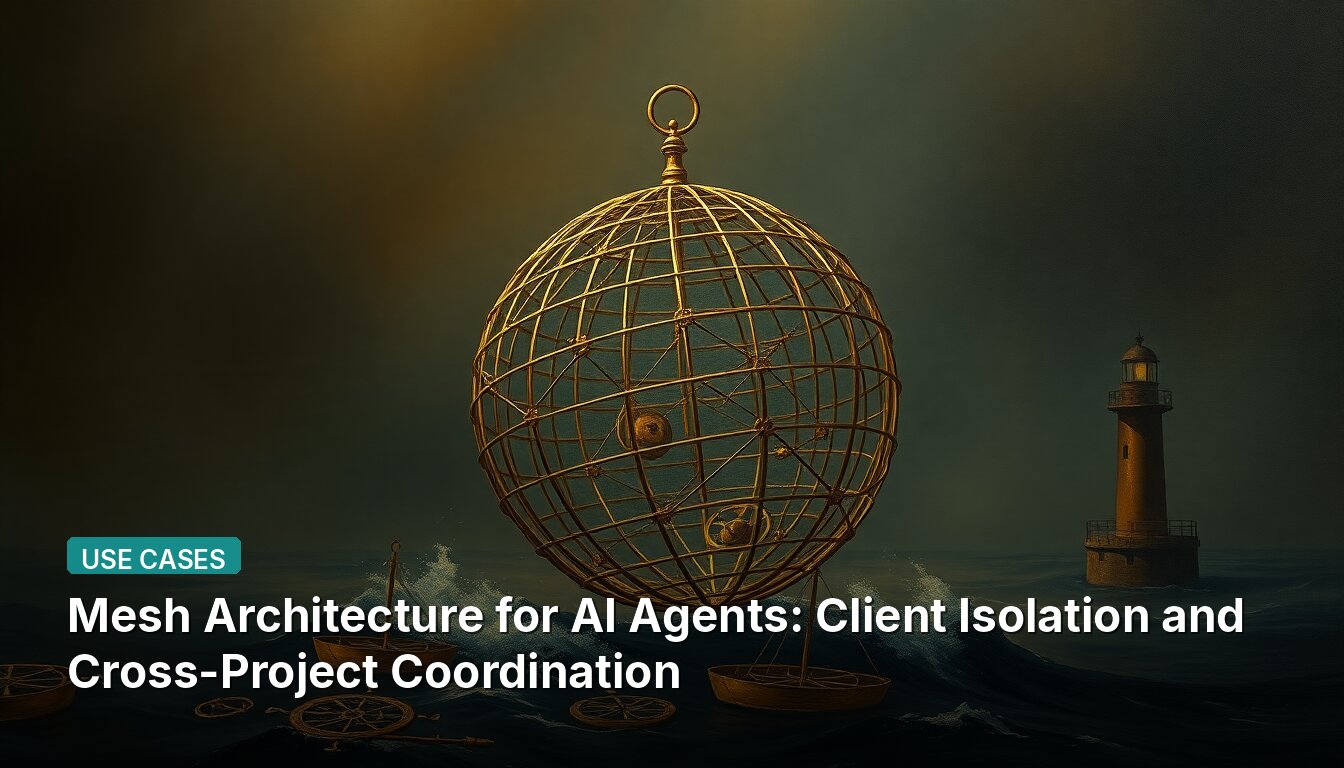
The author contrasts their mesh approach with the hub-and-spoke model popularized by setups like Daniel Miessler's PAI. In hub-and-spoke, one central assistant with shared memory handles all workflows, which trades depth for breadth. The mesh architecture creates domain-specialist agents for each client's project, with each agent carrying deep project context without competing for memory space.
System Implementation Details
The system uses plain markdown files and naming conventions for coordination:
STATE.mdfor working memoryCLAUDE.mdandAGENTS.mdfor agent instructions- Structured memos for cross-project communication
- Git for version control underneath everything
There's no database, no platform, and no dependencies beyond CLI tools. Each project is its own node with its own state and instruction files, ensuring Client A's context is isolated from Client B's session.
Cross-Agent Communication
Agents coordinate by dropping structured memos (plain markdown files) into each other's incoming directories, similar to emails passing between team members. Examples include:
- A content agent finishing a draft that the developer agent picks up next session
- A sysadmin agent finding a bug and sending it to the web dev agent
- Infrastructure changes affecting websites
- Content decisions depending on project management input
- Requirements specs triggering development work
For projects needing true isolation where SSH access would defeat the purpose, the memo system extends to email so there's no direct access between environments.
Tool Agnostic Approach
The author uses Claude Code, Codex, Gemini CLI, and DeepAgent across different projects. Because the conventions are just files, there isn't a noticeable vendor boundary—a Claude agent can send a memo that a Codex agent picks up. Swapping vendors to meet project needs is a standard part of the workflow.
Practical Results
This system has been running on real client work for about a year, handling 44 projects across 14 organizations. The author previously carried all coordination between agents but now just reviews work instead of passing it along.
📖 Read the full source: r/ClaudeAI
👀 See Also
Building a 7-Agent AI Trading Desk with OpenClaw
Discover the setup of a 7-agent AI trading desk using OpenClaw, running on a Mac mini with Claude as the brain, featuring custom Flask dashboards and Cron jobs.
Building a macOS clipboard manager with Claude: A practical workflow case study
A developer built Buffer, an open-source macOS clipboard manager using Claude as a planning and pair programming partner, finding that starting with implementation plans before coding reduced wasted prompts and debugging.
Running Gemma 4 as a Local Autonomous Agent with Claude Code on 16GB VRAM
A developer successfully configured Google's Gemma 4 31B model to function as a local autonomous coding agent through Claude Code CLI v2.1.92, overcoming VRAM limitations and parsing issues using llama.cpp b8672 and custom Python routing.
Using Local LLM to Monitor Minecraft Bot AFK Sessions
A developer used a local LLM to monitor their Minecraft bot running Baritone for mining jobs, setting up screen monitoring to receive alerts when the bot dies or disconnects from the server.